 English
 русский
 Deutsch

News
Home / News / Industry News / Capacitor Specifications for Medium Frequency Induction Heating: What Matters
Content
A foundry operator once replaced failed capacitors every four months, even though every replacement unit matched the original voltage and kvar ratings exactly. The real fault only became visible after the actual operating frequency and cooling-water temperature were logged: the medium frequency induction heating capacitors were rated for 1000 Hz, but the inverter ran near 1800 Hz during melt cycles, and water flow sat 40 percent below the datasheet minimum.
Selecting medium frequency induction heating capacitors for an MF tank circuit comes down to five specifications: rated voltage, reactive power (kvar), frequency rating, cooling method and thermal limits, and the current-and-loss budget. Each one maps to a different failure mode, and each one must be checked against the real operating conditions of the furnace, not against the numbers printed on the failed part.
The rated voltage of a medium frequency induction heating capacitor defines the maximum continuous RMS voltage its dielectric and edge-foil system can withstand, not the voltage you intend to run at. The insulation system, not the capacitance value, is the limiting factor at this stage.
Medium frequency inverters produce switching transients, load swings, and occasional arc events in the furnace coil. When the capacitor runs at 90 percent of its rated voltage, the remaining margin has to absorb all of that. Industry practice for induction heating banks is to select a capacitor whose rated voltage is at least 20 percent above the maximum steady-state voltage measured at the capacitor bus. A 2.4 kV bus points to a 3.0 kV rated unit; a 2.8 kV bus with hard-switching inverters calls for a 3.6 kV unit.
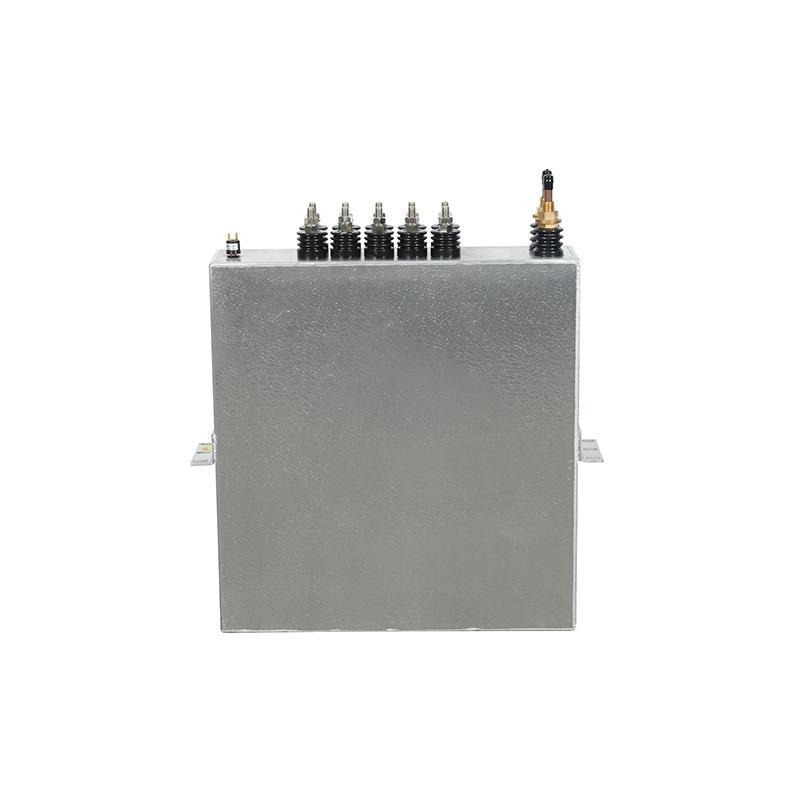
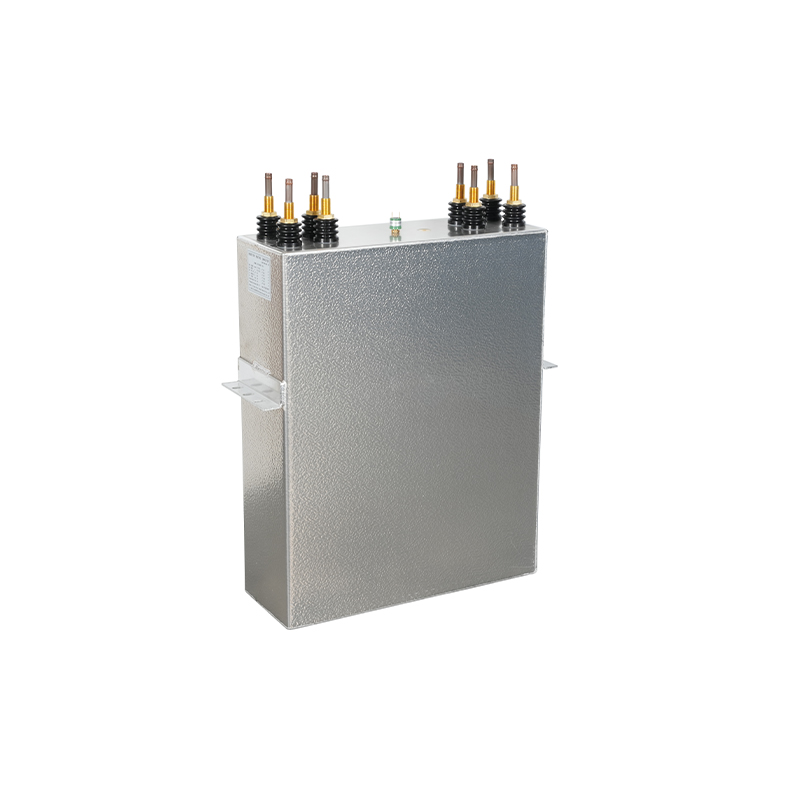 3.6kV 8000kvar Medium Frequency Induction Heating CapacitorRated at 3.6kV and 8000kvar, this capacitor suits hard-switching inverters on a 2.8kV bus. Its margin above steady-state voltage aligns with industry practice for furnace banks, making it a reliable choice for reactive power compensation and stable voltage in medium frequency systems.View Product →
The kvar rating tells you how much reactive power the capacitor can deliver continuously at its rated voltage and frequency, and it is the primary number used to size a capacitor bank for a furnace.
The governing relationship is Q = 2 x pi x f x C x U^2, where Q is reactive power in volt-amperes reactive, f is frequency in hertz, C is capacitance in farads, and U is the RMS voltage in volts. Because frequency sits in the numerator, a higher operating frequency needs much less capacitance to produce the same kvar. For a 3 kV capacitor delivering 1000 kvar:
This is why a kvar figure is meaningless without its frequency. A quotation that says "8400 kvar at 700 Hz" refers to a specific operating point; the same capacitor bank cannot simply run at 3000 Hz without re-verifying voltage, current, and thermal behavior.
The frequency rating is the operating condition that most directly drives internal losses, because dielectric and electrode losses scale with frequency and with the current density in the metalized film.
Medium frequency induction heating systems typically operate between 500 Hz and 3000 Hz. Below 500 Hz, the required capacitance becomes large and bulky; above 3000 Hz, losses climb and the capacitor must be designed with thinner electrode sections and more aggressive cooling. A 50/60 Hz power capacitor installed in an MF furnace circuit will overheat internally within minutes, not because the voltage is wrong, but because the dielectric losses at 1000 Hz are far above the capacitor's design budget.
Manufacturers publish frequency ratings differently: some state a single test frequency, others give an operating band. Verify that the quoted kvar and current values apply at the frequency you actually run, and ask the supplier for a derating curve when the operating point sits close to the edge of the band.
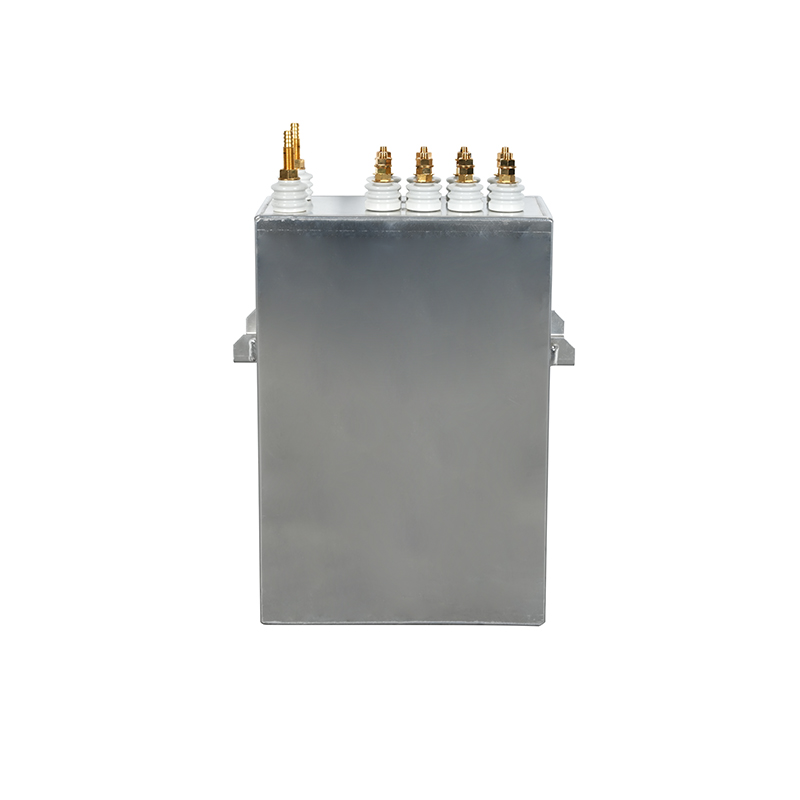
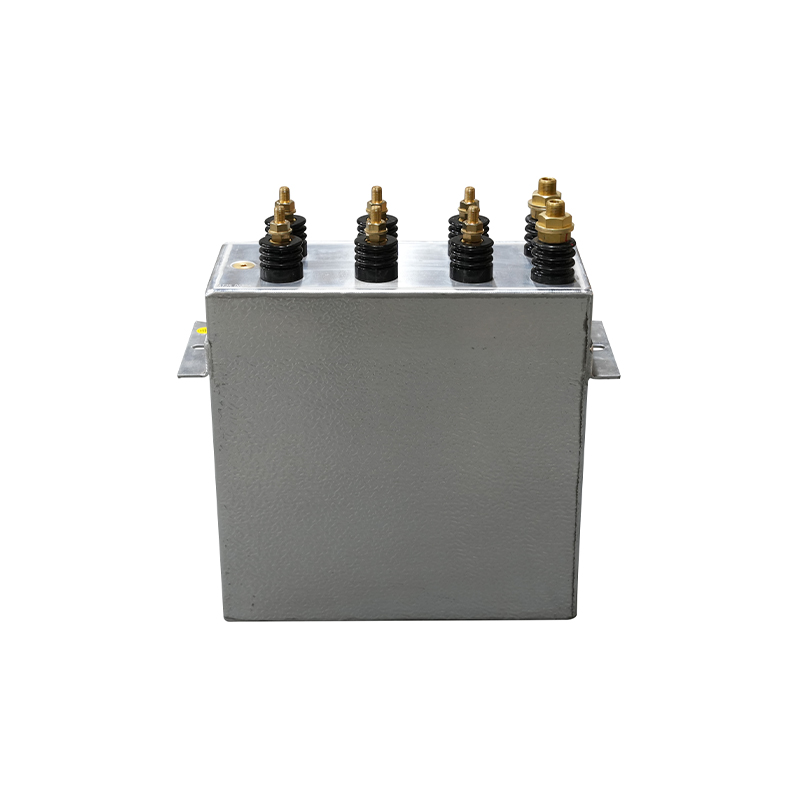 RAM 2200V 3960KVar 3000Hz Medium Frequency Induction Heating CapacitorDesigned for high-frequency induction heating at 3000Hz, this capacitor offers 2200V and 3960kvar for demanding applications like aerospace and automotive. Its high capacity and thermal design support efficient energy conversion, precise temperature control, and extended service life in metal processing.View Product →
Cooling method is the specification buyers underrate most, because it is not a single number on the datasheet; it is the entire thermal path between the capacitor element and the plant water or air system.
Water-cooled medium frequency capacitors use internal copper tube cooling structures that carry heat directly out of the winding. Air-cooled units rely on forced airflow over the case and are usually limited to lower power densities or intermittent duty. The choice defines how many kilovars each centimeter of film can handle before the hot spot exceeds the safe limit.
For a water-cooled unit, the datasheet values that matter are minimum water flow, maximum inlet temperature, and maximum pressure drop. Many field failures trace back to water flow that is nominally present but 30-40 percent below the required rate because of a partially blocked filter or an undersized pump.
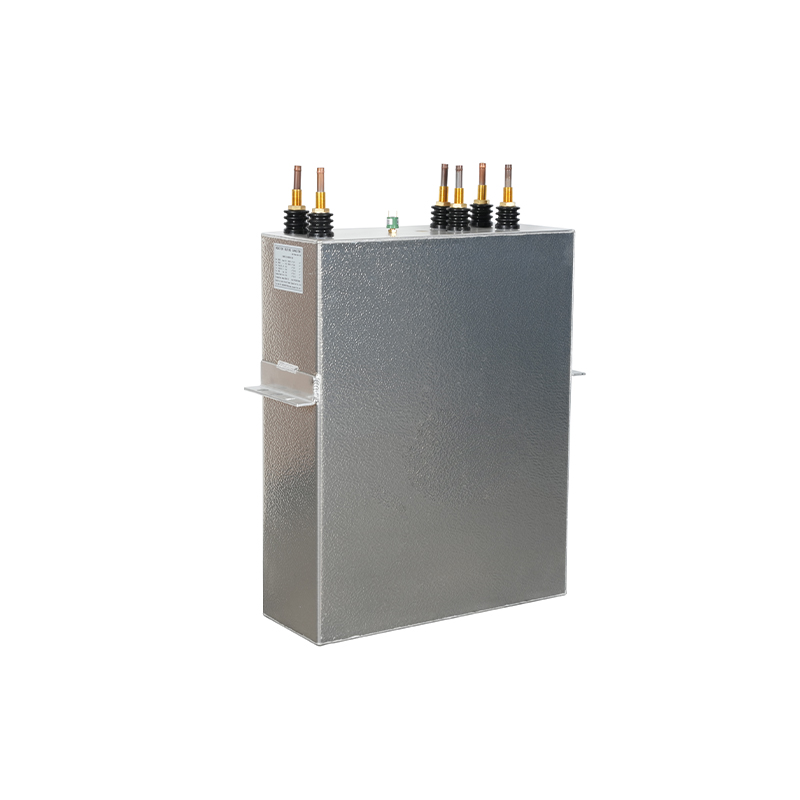
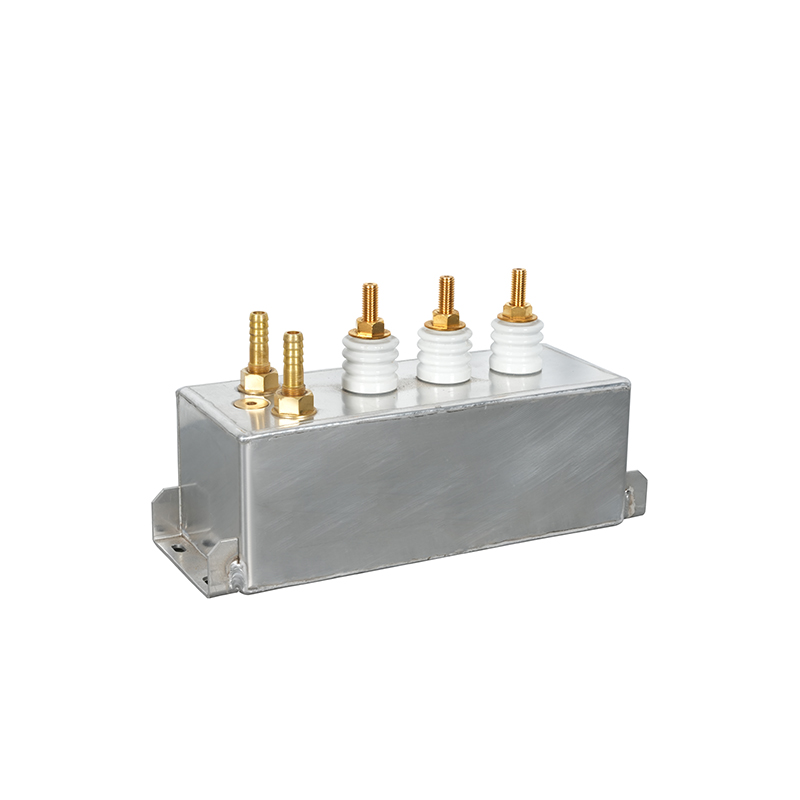 1.5kV 4000kvar 1000Hz Induction Heating Water Cooling CapacitorThis water-cooled capacitor handles 1000Hz and 4000kvar, with an efficient cooling system to keep temperatures low at high loads. Ideal for metal smelting and heat treatment, it improves power factor and reduces line losses, ensuring reliable performance in industrial heating systems.View Product →
The current rating accounts for the RMS current the internal electrode and connection system can carry without exceeding the hot-spot temperature. It belongs in the same sentence as voltage and kvar, because a capacitor can be correctly rated for both and still fail from current density.
Two losses matter. Dielectric losses follow the dissipation factor (tan delta) of the polypropylene film, which stays low but rises with frequency. Electrode and connection losses follow I^2 x R in the metalized layers and solder joints, and they dominate at medium frequency. The sum of both becomes heat that the cooling system must remove.
When a datasheet omits the current rating or the dissipation factor, treat the omission as a red flag. Those two values determine whether the capacitor can actually deliver its rated kvar for a full production shift without accelerated aging.
Work from the inverter output and the tank circuit, not from the nameplate of the failed unit. A failed capacitor may have been wrong from day one, and copying its ratings reproduces the same failure.
| Specification | What to verify | Typical MF range |
| Rated voltage | Bus voltage under worst melt condition plus 20 percent margin | 1.5-4.0 kV |
| Reactive power | Required kvar at the exact operating frequency | 1000-8500 kvar per unit |
| Frequency | Inverter output during the full melt cycle | 500-3000 Hz |
| Cooling | Water flow, inlet temperature, pressure drop, or air volume | 5-15 L/min water |
| Current rating | RMS current at rated frequency and kvar | Stated per capacitor |
Then check the physical constraints: terminal spacing, mounting footprint, and whether the capacitor's cooling connections match your existing manifold. A technically correct capacitor that does not fit the cabinet is still a failed project. When data is missing, ask the supplier directly. Jiande Antai Power Capacitor Co., Ltd., a manufacturer focused on induction heating and melting capacitors for over 40 years, lists rated voltage, kvar, frequency, and cooling parameters for each model and provides application-level support through its service team.
No. Oversizing kvar changes the tank circuit tuning and can increase the current stress on the inverter and the coil. Select the kvar that matches the furnace design at the actual frequency, or ask the capacitor manufacturer to calculate the correct value for your circuit.
Because dielectric and electrode losses scale with frequency. A capacitor designed for 50/60 Hz is not sized for the internal heat generated at 1000 Hz, so the hot spot rises until the film breaks down. The voltage was never the problem.
It depends on the loss budget of the specific unit, but a medium-size capacitor typically needs 5-15 liters per minute with an inlet temperature at or below 35 degrees Celsius, using deionized or treated water. Confirm the exact values on the datasheet and measure flow with a meter, not a gauge.
It means the capacitor can exchange that amount of reactive power continuously at its rated voltage and at 1000 Hz. If your system runs at a different frequency, the usable kvar changes, and the manufacturer should provide the derating curve.
Contact Us
News center
information
Tel: +86-571-64742598
Fax: +86-571-64742376
Add: Zhangjia Industrial Park, Genglou Street, Jiande City, Zhejiang Province, China
mobile