 English
 русский
 Deutsch

News
Home / News / Industry News / Selecting DC Filter Capacitors for High-Power Inverter Systems: A Practical Guide
Content
A 500 kW inverter DC bus was redesigned around a 1200 V film capacitor bank, and the thermal audit showed the capacitor case running 14 K above ambient under full ripple load. The capacitance value was inside spec, but ESR had drifted upward by 22 percent over the operating season. That field experience is why selecting DC filter capacitors for high-power inverter systems cannot stop at matching farads and volts: ripple current, hot-spot temperature, and the margin between the datasheet rating and the real waveform decide whether the capacitor bank survives.
Jiande Antai Power Capacitor Co., Ltd. has manufactured metallized film capacitors for induction heating, melting, and power electronics applications for 40 years, and its DZMJ series DC filter capacitors are built around these exact constraints. This guide works through the selection decisions in the order they affect system reliability.
The selection process has four layers: voltage rating, capacitance and ripple current, thermal management, and lifetime expectancy. Each layer eliminates candidates, so a structured approach prevents the most common failure mode, which is choosing a capacitor that matches the capacitance value but overheats at the operating frequency.
The voltage rating of a DC filter capacitor must be chosen for the worst-case transient across the bus, because the stress on the metallized film is proportional to the peak voltage it sees, not the average.
When the inverter bridge commutates, the DC link sees overshoot from cable inductance and busbar geometry. A 900 V DC bus with a 1200 V IGBT can experience 950 to 1050 V transients at turn-off, and every additional 50 V of overshoot raises the electric field inside the film. Industry practice is to rate the capacitor at least 10 to 20 percent above the steady-state bus level, which for a 900 V bus means selecting a 1100 V or 1200 V-rated part. The same derating logic runs through the DZMJ range used in industrial drives and renewable inverters.
Altitude adds a second constraint. Above 2000 m, dielectric strength and cooling capacity both decline, so a capacitor that passes at sea level may need a higher voltage class in a high-altitude plant. Confirm the rated altitude on the datasheet before locking the part number.
Capacitance determines how far the DC bus voltage dips between switching pulses, while ripple current and equivalent series resistance (ESR) determine how much switching energy is dissipated as heat inside the winding.
The capacitance requirement comes from the allowed voltage dip dV during a load step. For a three-phase inverter, minimum capacitance is approximately C = P_out / (2 x f_line x V_bus x dV), where P_out is the output power, f_line is the line frequency, and V_bus is the DC bus voltage. Doubling capacitance halves the dip on paper, but also doubles the footprint, weight, and cost of the bank.
The operating constraint is almost always ripple current. In a 500 kW inverter at 1200 V DC, the switching-frequency ripple can reach 60 to 100 A. This current flows through the ESR, and the heat generated scales with ripple current squared times ESR. A metallized film capacitor with an ESR of 0.5 milliohm at 25 °C stays cool at moderate ripple, while a part with degraded terminations or a high tan delta runs several times hotter in the identical circuit.
Antai's technical analysis of DC filter capacitors in power electronics systems explains this stabilizing function in more detail.
| Parameter | Why it matters | Typical target for a 500 kW inverter |
| Capacitance | Limits bus voltage dip under load steps | 1850 to 5000 uF |
| Voltage rating | Provides transient headroom | 1200 V DC minimum |
| ESR / tan delta | Controls internal heating from ripple | tan delta below 0.002 at 1 kHz |
| Ripple current | Sets the continuous thermal budget | 60 to 100 A at 60 °C case |
| Cooling interface | Determines real thermal resistance | Air or water cooling per cabinet |
For this voltage class, the DZMJ-1200V metalized film 1850 uF DC filter capacitor offers a compact air-cooled option, suited to applications where continuous ripple stays below roughly 60 A per unit.
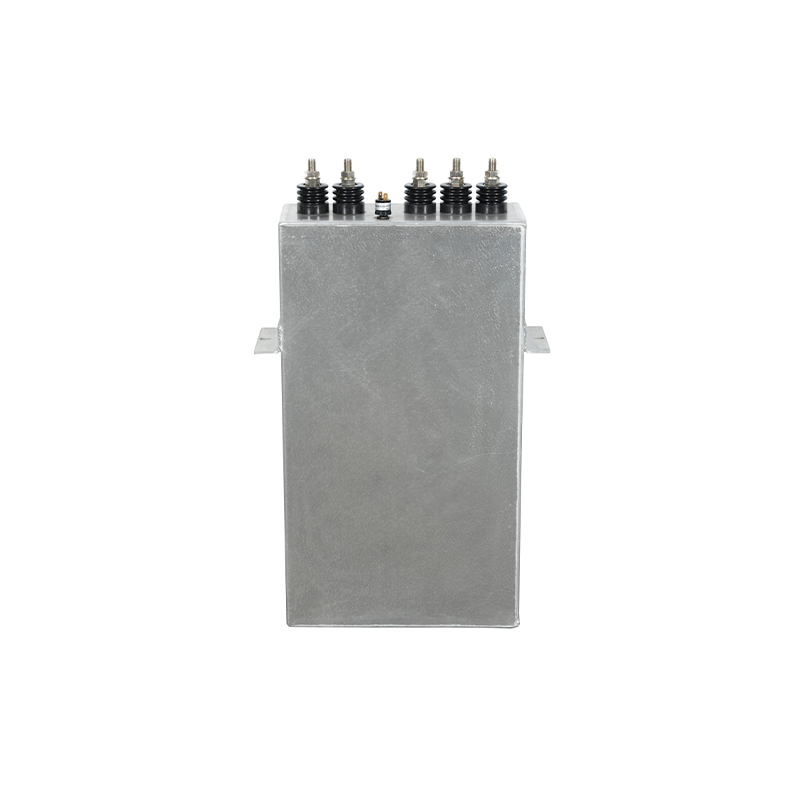 DZMJ 1200V 1850uF Metallized Film DC Filter CapacitorAn air-cooled 1850 µF capacitor rated at 1200 V, suited for continuous ripple below 60 A per unit. Its compact design fits power filtering in inverters, DC supplies, and UPS systems.View Product →
Water cooling can more than double the useful ripple current of a DC filter capacitor compared with natural convection, so the thermal path should be settled before the final ripple rating is confirmed.
Heat is generated uniformly across the metallized film winding and leaves mainly through the case. Natural convection depends on cabinet airflow and exposed case area, and a typical DC film capacitor dissipates roughly 30 to 60 W in free air. Forced air approximately doubles that limit. Water cooling through a cold plate, a cooling jacket, or a hollow busbar extracts heat directly from the case and supports 100 A-class ripple with the same winding technology.
Simpler system with no coolant loop; 40 to 70 percent of datasheet ripple rating available at high ambient temperatures; lower installed cost; easier maintenance.
Higher continuous ripple current, lower case temperature, and longer life; requires a coolant circuit, fittings, and leak management in the cabinet design.
In a comparative thermal run on the same 500 kW profile, the water-cooled bank held a 62 °C case temperature while the natural-convection bank reached 81 °C in an identical cabinet. That 19 K difference moves the winding hot-spot temperature directly into the lifetime curve. The DZMJ-1200V water cooling 5000 uF filter capacitor is built for this regime, with a cooling structure sized for continuous high-ripple operation.
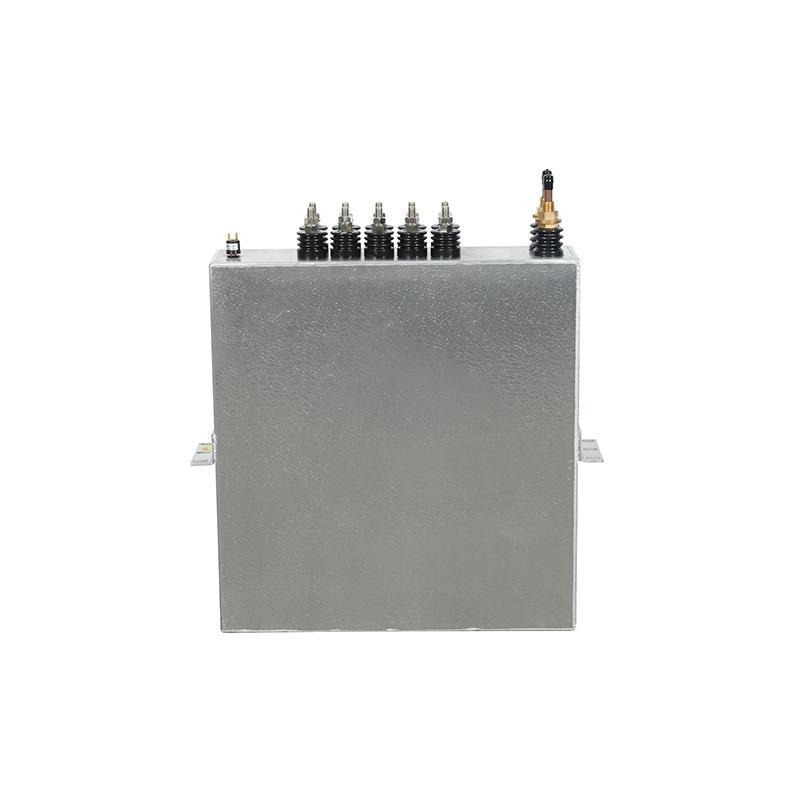 DZMJ 1200V Water-Cooled 5000uF Filter CapacitorWater cooling keeps the case at 62 °C under a 500 kW profile, improving ripple current capability and lifetime. Designed for high-voltage, high-current filtering in inverters and motor drives.View Product →
A metallized film capacitor does not fail suddenly like an electrolytic: it self-heals after micro-discharges, loses capacitance gradually, and its useful life is governed almost entirely by hot-spot temperature.
During a micro-discharge, the thin metal layer around the fault vaporizes and restores insulation, so a single overvoltage event rarely ends the part. Repeated thermal stress accelerates film aging and raises dielectric loss over time. Design practice for high-power DC links is to hold the hot-spot temperature below 85 to 90 °C, and every 10 K reduction roughly doubles the expected life. That relationship is why the cooling decision in the previous section is also a lifetime decision.
For bus voltages above 1200 V, the high-voltage DZMJ DC filter capacitor extends the same metallized film structure to higher operating levels, which is useful when the inverter is designed with extra derating margin.
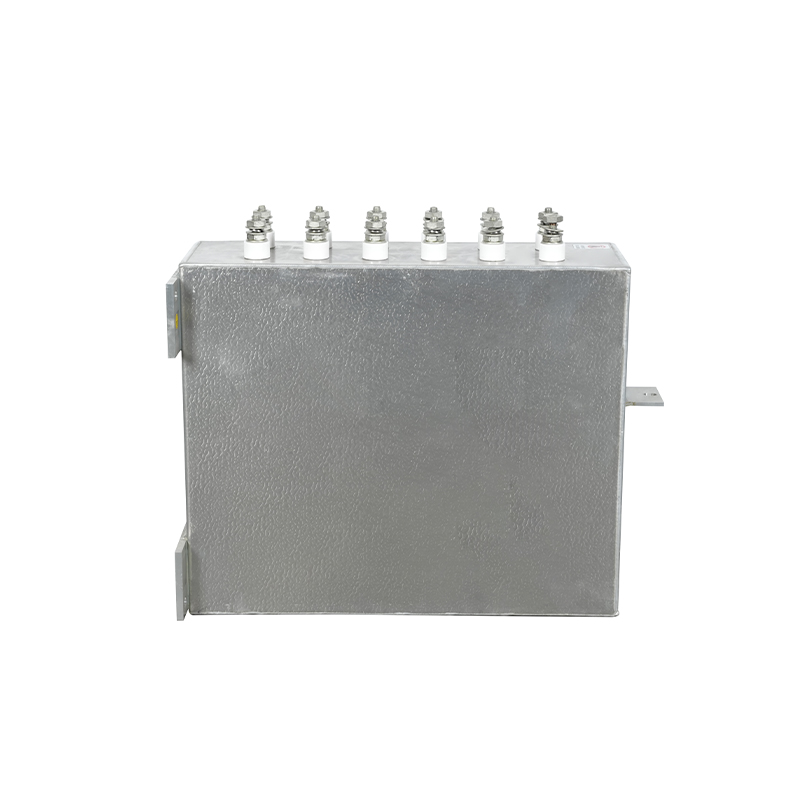 5000µF High-Voltage DZMJ DC Filter CapacitorA 5000 µF capacitor built for high-voltage DC applications, offering stable filtering with low losses. Useful when inverters require additional derating margin above 1200 V bus levels.View Product →
Finish the selection with a six-step verification sequence:
When the ripple profile includes fast transients or the cabinet geometry is tight, discuss the waveform with Antai's engineering team and validate the capacitor's cooling structure against your busbar layout before committing to production.
The bus voltage dips further during load steps, ripple voltage increases across the bank, and the capacitor operates above its ripple rating. The resulting thermal stress accelerates film aging and termination degradation, shortens service life, and in extreme cases triggers the protective disconnect.
Film capacitors handle higher ripple current, contain no liquid electrolyte to dry out, and fail in a self-healing mode rather than as a short circuit. Electrolytic capacitors remain useful below roughly 100 kW, where stored energy per unit volume matters more and ripple is low.
Use at least 10 percent above the steady-state bus voltage, and 15 to 20 percent if the inverter operates on a soft grid or sees frequent fast load steps. A 1200 V-rated film capacitor is standard for a 1000 V bus, while a 1200 V nominal bus should use a 1400 V or 1500 V class.
The hot-spot temperature is the product of internal loss, which is ripple current squared times ESR, and the thermal resistance from the winding to ambient. A better cooling path lowers that thermal resistance, allowing the same winding to carry more ripple current without exceeding the rated hot-spot temperature.
Contact Us
News center
information
Tel: +86-571-64742598
Fax: +86-571-64742376
Add: Zhangjia Industrial Park, Genglou Street, Jiande City, Zhejiang Province, China
mobile