Content
Induction heating and melting systems have revolutionized industrial processing. From forging and hardening to melting and brazing, induction technology offers precise, efficient, and clean heat generation. At the heart of every induction system lies a network of capacitors. These components store electrical energy, provide power factor correction, and enable the resonant circuit that makes induction heating possible.
However, capacitors in induction applications face extreme conditions. High currents, high frequencies, and continuous operation generate significant internal heat. Without effective thermal management, capacitor temperature rises, leading to reduced lifespan, capacitance drift, increased losses, and ultimately catastrophic failure. This is where cooling method becomes a critical design decision.
This article provides a comprehensive technical comparison of water cooled capacitors against air cooled alternatives for induction heating and melting applications. We will examine thermal performance, power density, reliability, installation requirements, and total cost of ownership. For engineers and procurement professionals, this guide serves as a reference for selecting the appropriate capacitor cooling technology for different power levels, frequencies, and operating environments.
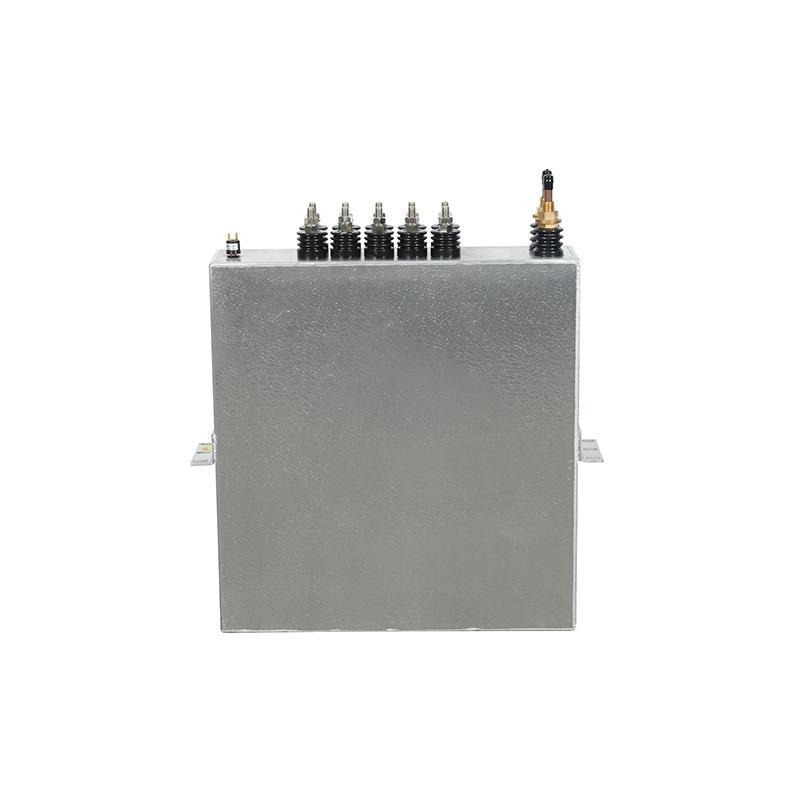
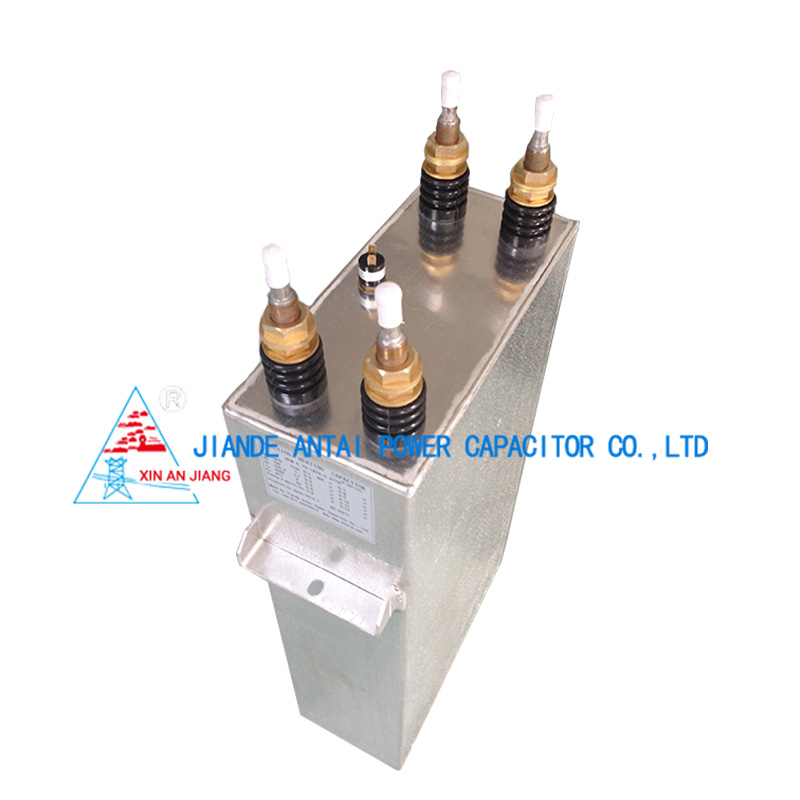
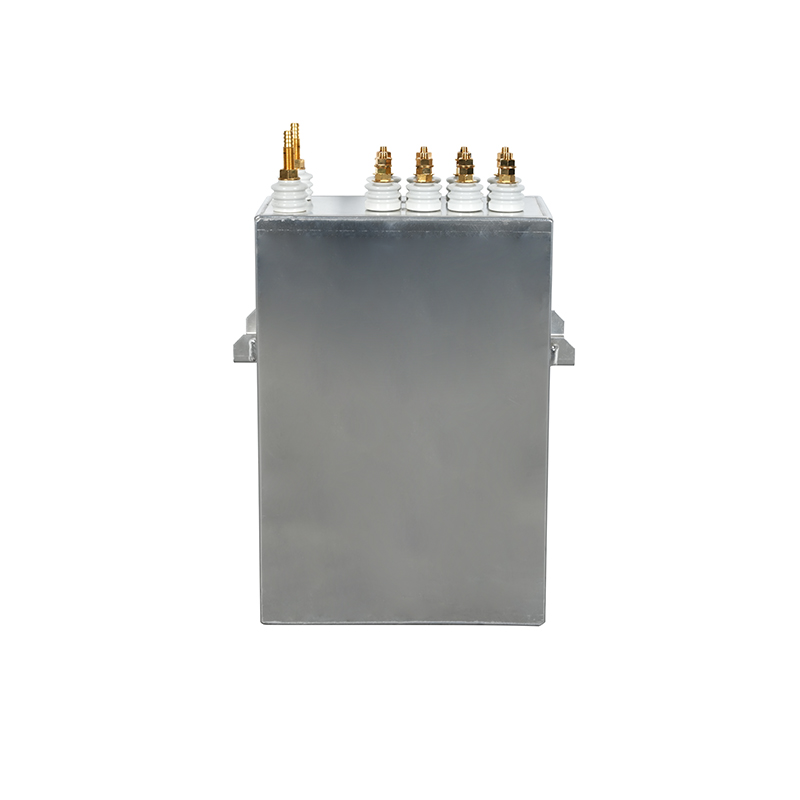
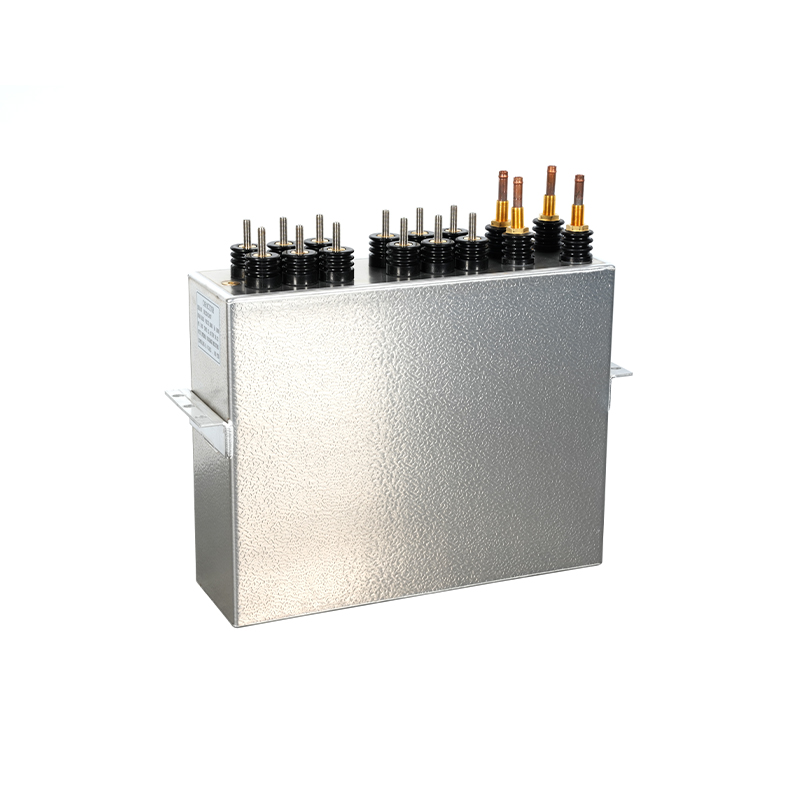
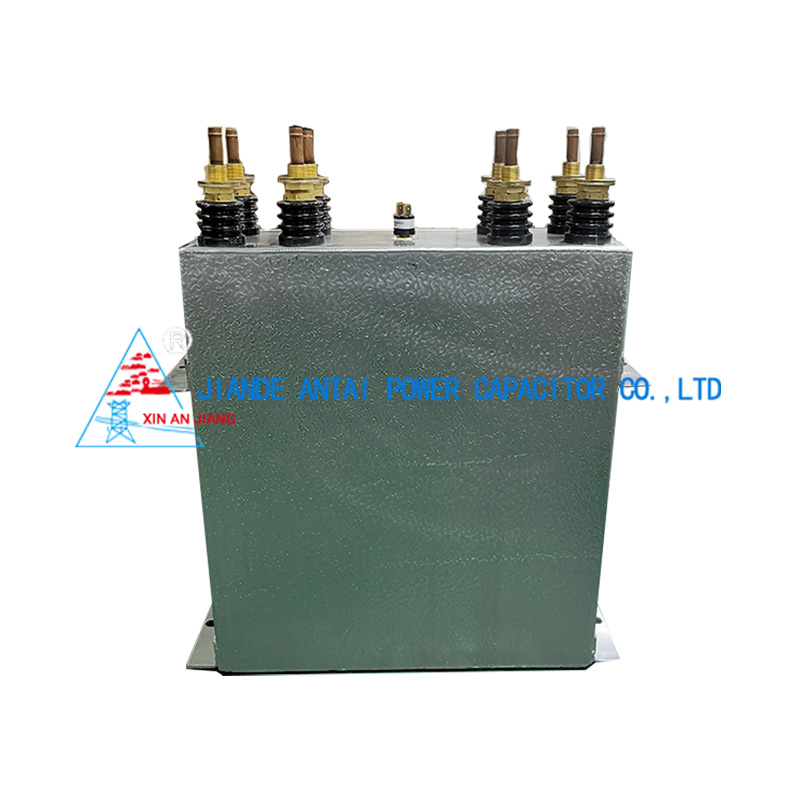
A water cooled capacitor is a specialized electrical component designed to operate in high power, high frequency induction systems. Unlike standard capacitors that rely on natural or forced air convection for cooling, water cooled capacitors integrate a liquid cooling circuit directly into the capacitor body.
The construction of a water cooled capacitor begins with the dielectric and electrode materials. High quality capacitors, such as those manufactured by specialized facilities, use polypropylene film as the dielectric and high purity aluminum foil as the electrode. These materials are chosen for their low dielectric loss, high breakdown field strength, and stability over temperature.
The winding assembly consists of multiple layers of film and foil wound into a cylindrical or flattened shape. This assembly is then subjected to a high vacuum environment to remove air and moisture. A non PCB electrical grade insulating oil impregnates the winding under vacuum, filling all voids and improving dielectric strength.
The critical feature of a water cooled capacitor is the cooling tube system. High thermal conductivity copper tubes are embedded within or attached to the capacitor winding assembly. Cooling water flows through these tubes, carrying heat away from the capacitor core. The water absorbs heat as it passes through the capacitor and releases it to an external heat exchanger or cooling tower.
For induction heating and melting applications, water cooled capacitors are available in a range of electrical specifications. Typical ratings include voltages up to 8000 volts AC, reactive power up to 14,000 kilovolt amperes reactive, and frequencies up to 100 kilohertz. Both tapped and untapped configurations are available, as are horizontal and vertical mounting orientations.
The fundamental difference between water cooled and air cooled capacitors lies in the heat transfer medium and the resulting thermal performance. This difference drives all other comparison points.
Air cooled capacitors rely on natural convection or forced air from fans to remove heat. The capacitor housing is designed with fins or a smooth surface that exposes as much area as possible to the surrounding air. Heat travels from the capacitor core to the housing through the impregnated winding and the casing material, then from the housing to the air.
Water cooled capacitors use water as the heat transfer medium. Water has a thermal conductivity approximately 25 times higher than air and a specific heat capacity approximately 4 times higher. This means water can absorb and transport significantly more heat per unit volume than air. The cooling water flows directly through tubes embedded in the capacitor core, removing heat at its source rather than relying on conduction through multiple layers.
The table below compares water cooled and air cooled capacitors across key parameters.
| Parameter | Water Cooled Capacitor | Air Cooled Capacitor |
|---|---|---|
| Heat Transfer Coefficient | Very High 500-2000 W/m²K | Low 10-100 W/m²K |
| Power Density | High can exceed 14,000 kVAr | Moderate typically under 1000 kVAr |
| Operating Temperature | Stable typically 30-45°C inlet | Variable depends on ambient |
| Thermal Time Constant | Short rapid heat removal | Long heat accumulates |
| Physical Size | Smaller for same power rating | Larger for same power rating |
| Auxiliary Equipment Required | Cooling tower, pump, piping | Fans or natural convection |
| Installation Complexity | High requires water infrastructure | Low plug and play |
| Maintenance Requirements | Moderate water treatment, leak checks | Low fan cleaning |
| Best Application | High power >500 kVAr, continuous duty | Low power <500 kVAr, intermittent duty |
For high power induction melting furnaces operating at hundreds of kilowatts or megawatts, water cooling is not optional. The heat generated within the capacitors would quickly destroy air cooled units. For smaller induction heaters operating intermittently, air cooling may be sufficient.
Industrial induction systems operate in diverse environments. A melting furnace in Northern Europe may see ambient temperatures below freezing in winter. A forging facility in Southeast Asia may operate at 40°C with high humidity. Water cooled capacitors must perform reliably across this range.
At low ambient temperatures down to minus 20°C, the primary concern is freezing of the cooling water. If water freezes within the capacitor cooling tubes, expansion can rupture the tubes, destroying the capacitor. Proper water cooled system design includes antifreeze additives or the use of a water glycol mixture. Temperature sensors can trigger circulation pumps to keep water moving even when the system is not under power.
At high ambient temperatures up to 50°C, the concern is insufficient heat rejection. The cooling water inlet temperature must be maintained below 30°C for optimal capacitor performance. The maximum outlet water temperature should not exceed 45°C. If the cooling tower or heat exchanger cannot reject heat effectively at high ambient temperatures, the capacitor may overheat.
Water cooled capacitors demonstrate stable electrical performance across the ambient temperature range. The polypropylene dielectric maintains its properties from minus 20°C to plus 50°C. The vacuum impregnation process removes moisture that could condense or freeze, preventing internal arcing or dielectric breakdown. The insulating oil remains fluid at low temperatures and does not volatilize excessively at high temperatures.
Air cooled capacitors are more directly affected by ambient temperature. A 40°C ambient means the capacitor housing cannot cool below 40°C, significantly reducing the temperature gradient that drives heat transfer. In hot environments, air cooled capacitors may require derating or additional forced air cooling.
The reliability of a water cooled capacitor depends heavily on the quality of its internal construction. A well built capacitor will operate for years under harsh conditions. A poorly built capacitor may fail within months.
The dielectric system consists of the polypropylene film, the aluminum foil electrodes, and the impregnating oil. Polypropylene film is chosen for its low dielectric loss tangent, typically below 0.0008 at 20°C. Low loss means less heat generated within the capacitor for a given reactive power. The film thickness is selected based on the rated voltage, with thicker films providing higher voltage withstand capability.
The aluminum foil electrodes are interleaved with the film layers. High purity aluminum ensures low resistance and consistent electrical properties. The foil edges must be clean and free of burrs that could concentrate electric stress and initiate breakdown.
The vacuum impregnation process is critical. The winding assembly is placed in a vacuum chamber, and air is evacuated to a very low pressure. This removes moisture and air bubbles from between the film layers. Then the insulating oil is introduced while still under vacuum. The oil penetrates every void, displacing any remaining gas. Properly impregnated capacitors have consistent dielectric strength throughout the winding.
Water cooled capacitors should be tested before leaving the factory. Standard tests include sealing tests to verify no water leakage, voltage tests between terminals at 4 times rated DC voltage for 10 seconds, voltage tests between terminal and shell at 2.5 times rated AC voltage or minimum 2 kilovolts for 1 minute, capacitance measurement within minus 5 to plus 10 percent of rated value, and loss tangent measurement at 20°C.
When you select a Water Cooled Capacitors for Induction Heating & Melting, request documentation of these factory tests to verify quality.
Water cooled capacitors for induction systems are available in tapped or untapped configurations. The choice affects system flexibility and cost.
An untapped capacitor has a single fixed capacitance value. It is connected directly to the induction coil and power supply. The system operates at a single resonant frequency determined by the coil inductance and the fixed capacitance. Untapped capacitors are simpler, less expensive, and have fewer internal connections that could fail.
A tapped capacitor has multiple electrical connection points along the internal winding. By connecting to different taps, the user can select different capacitance values from the same physical capacitor. This allows the system operator to adjust the resonant frequency or match different coils without changing capacitors.
Tapped capacitors are valuable in systems that process different workpiece sizes or materials. Changing the workpiece changes the electrical characteristics of the induction coil. Adjusting the capacitance restores optimal matching and power transfer. Tapped capacitors also allow fine tuning of the power factor.
| Feature | Untapped Capacitor | Tapped Capacitor |
|---|---|---|
| Capacitance Options | One fixed value | Multiple selectable values |
| System Flexibility | Low | High |
| Internal Complexity | Simple single winding | Complex with tap connections |
| Cost | Lower | Higher |
| Reliability | Higher fewer internal connections | Moderate more potential failure points |
| Best Application | Fixed frequency, single coil systems | Variable frequency, multiple coil systems |
For most induction melting furnaces, which operate at a consistent frequency and with a fixed coil, untapped capacitors are sufficient. For induction heating systems that process a variety of part sizes and require frequency adjustment, tapped capacitors provide valuable flexibility.
Water cooled capacitors can be mounted horizontally or vertically. The choice affects space utilization, cooling performance, and maintenance access.
Horizontal mounting places the capacitor with its length axis parallel to the ground. This configuration is common in equipment cabinets and control rooms where vertical space is limited. Horizontal mounting allows the cooling water connections to be made at the ends or on the top surface. Air bubbles within the cooling system may become trapped at the top of horizontally mounted capacitors, requiring careful system design to ensure consistent water flow.
Vertical mounting places the capacitor with its length axis perpendicular to the ground. This orientation allows any air bubbles in the cooling water to rise naturally to the top and exit through the outlet connection. Vertical mounting also typically provides a smaller footprint on the equipment floor, though with greater height. Cooling water connections are usually at the top and bottom.
For high power systems with multiple capacitors, vertical mounting in racks or arrays is common. The vertical orientation simplifies water manifold design and ensures consistent flow through all capacitors. For retrofitting into existing equipment with limited height, horizontal mounting may be the only option.
Consider the following factors when selecting mounting orientation. Available space in the equipment cabinet or room. Direction of cooling water supply and return lines. Need for access to electrical connections and taps. Vibration and seismic requirements for the installation.
The capacitor casing or housing provides mechanical protection, electrical safety, and environmental sealing. Two common materials are aluminum and stainless steel.
Aluminum casings are lighter in weight and have better thermal conductivity than stainless steel. Aluminum conducts heat away from the capacitor winding to the surrounding environment, providing secondary cooling even when the water cooling system is the primary heat removal path. Aluminum is also less expensive than stainless steel. However, aluminum has lower corrosion resistance, particularly in humid or chemically aggressive environments.
Stainless steel casings offer superior corrosion resistance. Type 304 stainless steel is adequate for most indoor industrial environments. Type 316 stainless steel with added molybdenum is recommended for coastal areas or facilities with exposure to salt or corrosive chemicals. Stainless steel is heavier and more expensive than aluminum. Its lower thermal conductivity means less secondary cooling, but this is rarely significant when water cooling is properly implemented.
| Feature | Aluminum Casing | Stainless Steel Casing |
|---|---|---|
| Weight | Light | Heavy |
| Thermal Conductivity | High 205 W/mK | Low 15 W/mK |
| Corrosion Resistance | Moderate | High |
| Cost | Lower | Higher |
| Appearance | Matte or brushed finish | Bright or brushed finish |
| Best Application | Indoor, dry environments | Humid, coastal, or chemical environments |
For most induction heating and melting installations indoors, aluminum casings are sufficient and cost effective. For facilities with washdown requirements, outdoor installations, or coastal locations, stainless steel is recommended.
Water cooled capacitors are available in two electrical safety configurations: live case and isolated dead case.
In a live case design, the capacitor casing is electrically connected to one of the terminals. The case is at the same potential as that terminal. This design is simpler and less expensive. However, the case must be mounted on insulated supports if it is not at ground potential. Live case capacitors require careful safety guarding to prevent personnel contact with the energized case.
In an isolated or dead case design, the capacitor casing is electrically isolated from both terminals. The case can be grounded directly, providing safety for personnel and a reference for protective relays. The isolation requires additional insulation and a more complex construction, increasing cost. However, the safety benefits are significant, particularly in systems with exposed capacitor banks.
For low voltage systems where the case potential is not hazardous, live case design is acceptable. For high voltage systems above 1000 volts, or where personnel may contact the capacitor enclosure, isolated dead case design is strongly preferred. Many industrial safety standards require grounded accessible enclosures for high voltage equipment.
The choice between live and dead case should be made in consultation with the system designer, considering the operating voltage, the installation environment, and applicable safety codes.
Water cooled capacitors for demanding induction applications should include protection devices that detect internal faults and remove power before catastrophic failure occurs.
A pressure switch is the most common protection device. The capacitor is sealed and filled with insulating oil. Under normal operation, internal pressure is low. If an internal arc or dielectric breakdown occurs, the fault vaporizes oil and dielectric material, creating a rapid pressure rise. The pressure switch detects this rise and sends a signal to open the circuit breaker or contactor, removing power from the capacitor.
The pressure switch is typically a normally closed contact that opens when pressure exceeds a threshold. Redundant pressure switches or switches with two sets of contacts provide additional reliability. The pressure switch should be connected to a fast acting protection relay that operates within milliseconds.
Thermal sensors can also be installed to monitor capacitor temperature. A thermocouple or resistance temperature detector mounted on the capacitor winding or cooling tube provides temperature feedback to the control system. If temperature exceeds a safe limit, the control system can reduce power or shut down the system before damage occurs.
Some water cooled capacitors include both pressure and thermal protection. The pressure switch detects sudden faults. The thermal sensor detects gradual overheating from cooling system failures or excessive power levels. Together, they provide comprehensive protection.
A water cooled capacitor is only as reliable as the cooling system that serves it. Poor water quality, inadequate flow rate, or excessive inlet temperature will shorten capacitor life regardless of the capacitor quality.
The required water flow rate depends on the capacitor power dissipation. For typical induction heating capacitors, a flow rate of 6 liters per minute per capacitor is often specified. Multiple capacitors in parallel require proportionally higher total flow. The flow must be sufficient to maintain the outlet water temperature below 45°C when the inlet is at the maximum 30°C.
Water quality is critical. The cooling water should be clean, filtered to remove particles that could clog cooling tubes, and treated to prevent scale formation and corrosion. Deionized or distilled water is recommended to prevent mineral deposits inside the cooling tubes. A closed loop system with a heat exchanger and corrosion inhibitor is preferable to once through city water.
The pressure drop across the capacitor cooling circuit must be considered in pump sizing. The internal cooling tubes present resistance to flow. The pressure drop increases with flow rate and with the number of capacitors in series. Capacitors are typically connected in parallel in the water circuit, not in series, to maintain adequate flow through each unit.
The temperature rise from inlet to outlet should be monitored. A rise of 10 to 15°C is typical at rated power. A higher rise indicates insufficient flow or excessive power dissipation. A lower rise may indicate low flow with the water absorbing heat and then being replaced by fresh water in a batch process, or may indicate that the capacitor is not operating at full power.
The choice between water cooled and air cooled capacitors for induction heating and melting applications is determined primarily by power level and duty cycle.
For low power systems below 500 kilovolt amperes reactive operating intermittently, air cooled capacitors offer simplicity and lower installation cost. No cooling water infrastructure is required. Maintenance is limited to keeping fans and vents clean. However, air cooled capacitors are larger for the same power rating and may require derating in hot environments.
For high power systems above 500 kilovolt amperes reactive operating continuously, water cooled capacitors are the only practical choice. The superior heat transfer of water allows compact, high power density designs. Water cooled capacitors maintain stable temperature regardless of ambient conditions, provided the cooling water system is properly designed. The additional cost of water infrastructure is justified by the increased power capability and longer service life.
For systems with power levels between 500 and 1000 kilovolt amperes reactive, either technology may be possible. Evaluate the ambient temperature range, available space, maintenance capabilities, and total cost of ownership including the water cooling system.
Water cooled capacitors for induction heating and melting represent a mature technology. When properly selected, installed, and maintained, they provide reliable service for many years. The key to success is attention to water quality, flow rate, and temperature monitoring.
By understanding the technical comparisons presented in this article, engineers and procurement professionals can confidently select the appropriate capacitor technology for their specific induction system requirements.
Q1: What is the maximum allowable inlet water temperature for a water cooled induction heating capacitor?
A: The maximum recommended inlet water temperature is 30°C. Above this temperature, the capacitor may not dissipate heat effectively, and internal temperature can rise to damaging levels. The maximum outlet water temperature should not exceed 45°C, representing a maximum temperature rise of 15°C. If inlet water exceeds 30°C, increased flow rate may partially compensate, but sustained operation above 30°C inlet is not recommended.
Q2: How often should the cooling water be replaced or treated in a capacitor cooling system?
A: In a closed loop system with proper water treatment, water can last 6 to 12 months before replacement is needed. Monitor water quality parameters including pH, conductivity, and microbial content. Deionized water should maintain conductivity below 10 microsiemens per centimeter. If corrosion inhibitors are used, test their concentration quarterly. Open loop or once through systems using city water should be avoided, as mineral scale will deposit inside the cooling tubes over time.
Q3: Can a water cooled capacitor be operated in freezing ambient temperatures?
A: Yes, but with precautions. The cooling water must contain antifreeze such as propylene glycol or ethylene glycol in sufficient concentration to prevent freezing at the lowest expected ambient temperature. The system should be designed to keep water circulating even when the induction system is off, using a small circulation pump. Alternatively, the system can be drained and refilled before each use, but this is impractical for frequent operation. Some installations use a water glycol mixture year round.
Q4: What is the expected lifespan of a water cooled capacitor in continuous induction melting service?
A: With proper cooling water quality, adequate flow rate, and operation within rated voltage and current, a well manufactured water cooled capacitor can last 5 to 10 years or more in continuous service. The limiting factor is often gradual loss of capacitance due to dielectric aging or gradual accumulation of internal heat related damage. Regular monitoring of capacitance and loss tangent can predict end of life. Capacitors that show a capacitance change beyond minus 5 to plus 10 percent or a significant increase in loss tangent should be replaced.
Q5: How do I know if my water cooled capacitor is failing internally?
A: Warning signs of internal failure include increased operating temperature for the same power level, reduced capacitance measured during routine maintenance, visible swelling or deformation of the casing, activation of the internal pressure switch causing nuisance trips, and bubbles in the cooling water return line indicating internal arcing. If any of these signs appear, remove the capacitor from service immediately and have it tested by a qualified technician or replace it.
Contact Us
News center
information
Tel: +86-571-64742598
Fax: +86-571-64742376
Add: Zhangjia Industrial Park, Genglou Street, Jiande City, Zhejiang Province, China